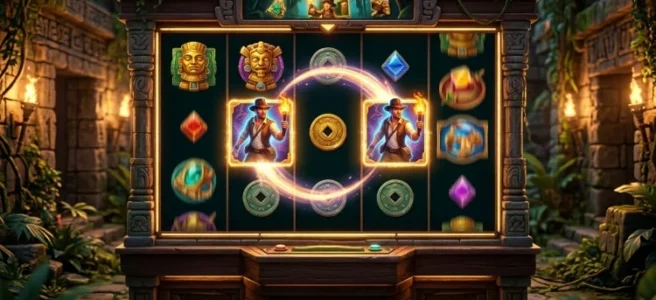
Wild symbols normally land, help form a winning combination, and disappear when the next spin begins.
Walking wilds change that familiar pattern by moving across the grid and often staying involved for several consecutive spins or respins.
So, How Do Walking Wilds Work in Slot Games? The basic idea is simple: a wild lands, triggers or participates in another spin, then moves to a new position according to the game’s rules.
However, developers have created many variations involving multipliers, stacked wilds, free spins, and even movement in different directions.
What Is a Walking Wild?
A walking wild is a wild symbol that changes position between consecutive spins or respins instead of immediately disappearing.
In many classic versions, the wild moves one reel toward the edge of the grid after each respin. Once it reaches the final reel and moves outside the play area, the sequence ends.
The wild usually continues substituting for normal symbols while it travels.
However, the exact mechancis depend on the game. Some walking wilds only move after participating in a winning combination, while others automatically move after every respin.
How Does a Typical Walking Wild Sequence Work?
Imagine a 5×3 slot where a walking wild lands on reel four.
The wild activates a respin. Before or during the next round, it moves to reel three. Another respin occurs, then it moves to reel two, followed by reel one.
After leaving reel one, the walking sequence ends.
New wilds may sometimes appear while the original is still moving. If the game permits this, several walking wilds can remain active simultaneously and extend the sequence.
This is why walking wilds can make one initial spin feel considerably longer than a standard round.
Jack and the Beanstalk Is a Classic Example
NetEnt’s Jack and the Beanstalk is one of the most recognizable examples of the feature.
Walking Wilds can appear during both the main game and free spins. Each one triggers a respin and moves one reel to the left after every respin until it eventually leaves the first reel.
The game also adds a 3x multiplier to qualifying wins involving its wilds.
During free spins, collected keys upgrade future wilds into double-stacked Money Bags, triple-stacked Golden Hens, and eventually Expanding Golden Harps.
This creates an easy-to-follow example of how a simple walking mechanic can gradually become more powerful during a bonus feature.
Walking Wilds Do Not Always Move Left
Moving one reel to the left is common, but it is not a universal rule.
Play’n GO’s Joker Flip demonstrates this clearly. A full stack of wild symbols on the middle reel can become a Walking Wild and trigger three respins.
During the base game it travels from left to right, while during Casino Free Spins it moves in the opposite direction.
Some games even use vertical movement.
In NetEnt’s Rabid Randy Gone Fishing, the Hook Wild begins on reel one and moves one position downward after every respin until it eventually disappears from the grid.
So “walking” describes movement rather than one specific direction.
Walking Wilds Can Carry Multipliers
Modern slots often combine moving wilds with additional modifiers.
Pragmatic Play’s Ra vs Osiris starts with expanding wild multiplier symbols. During its bonus game, these expanding wilds transform into walking wild multipliers, retain their multiplier value, trigger respins, and move one reel to the left until they leave the grid.
The multiplier attached to the wild can reach substantial values under the game’s rules.
That makes the symbol important for two reasons: it substitutes for regular symbols and can multiply qualifying wins while continuing to move.
This type of hybrid feature is more complicated than a traditional walking wild because several properties are operating at once.
Narcos Makes Winning Wilds Keep Moving
NetEnt’s Narcos uses another variation.
Its walking wild symbols move horizontally one position to the left after qualifying winning rounds. The process continues while winning wilds remain active. Walking Wilds can appear in both the base game and free spins.
The game also handles feature interaction differently.
If another feature starts while a walking wild is active, the wild can remain on the reel after that feature finishes. At the end of free spins, additional spins can also continue while Walking Wilds remain active.
This shows why players should check individual rules instead of assuming every walking-wild slot follows Jack and the Beanstalk’s structure.
Walking Wilds vs Sticky Wilds
Walking and sticky wilds both remain relevant for more than one game event, but they behave differently.
A sticky wild stays in the same position for multiple spins.
A walking wild changes position as the sequence progresses.
Some modern titles combine both ideas or attach additional effects to the moving symbol.
The distinction becomes especially important when reading bonus rules. A sticky wild can repeatedly help the same section of the grid, whereas a walking wild gradually changes which reels or positions it can influence.
Neither type automatically provides better odds. Their probability and value are already built into the game’s mathematical design.
Walking Wilds vs Expanding Wilds
Expanding wilds describe size rather than movement.
An expanding wild usually lands in one position and then grows to cover several positions, often the entire reel.
A walking wild changes location across consecutive rounds.
A game can combine the two. Wilderland from NetEnt includes an Expanding Walking Wild that covers an entire reel while also moving one reel to the left at the beginning of subsequent spins.
This is why slot terminology can sometimes appear confusing. One wild can be expanding, walking, multiplied, or even several of those things at the same time.
Do Walking Wilds Improve Your Chances?
During an active feature, having additional wild positions can clearly create more opportunities for qualifying combinations.
That does not mean a slot with walking wilds automatically has a higher RTP or better overall odds than a slot without them.
The frequency of the feature, symbol distribution, paytable, volatility, multipliers, and bonus probabilities are all part of the same mathematical model.
A visually powerful feature may therefore occur relatively rarely.
Instead of judging the game from the animation alone, check its RTP, volatility, hit frequency when published, and complete feature rules. Demo play can also make the experiance easier to understand without putting real money at risk.
How Do Walking Wilds Work in Slot Games? They move between reel positions across consecutive spins or respins while continuing to act as wild symbols.
Jack and the Beanstalk uses classic leftward movement, Joker Flip changes direction, and Ra vs Osiris adds multipliers. Check each game’s paytable and try an official demo to see exactly how its walking mechanic behaves before comparing it with other wild features.